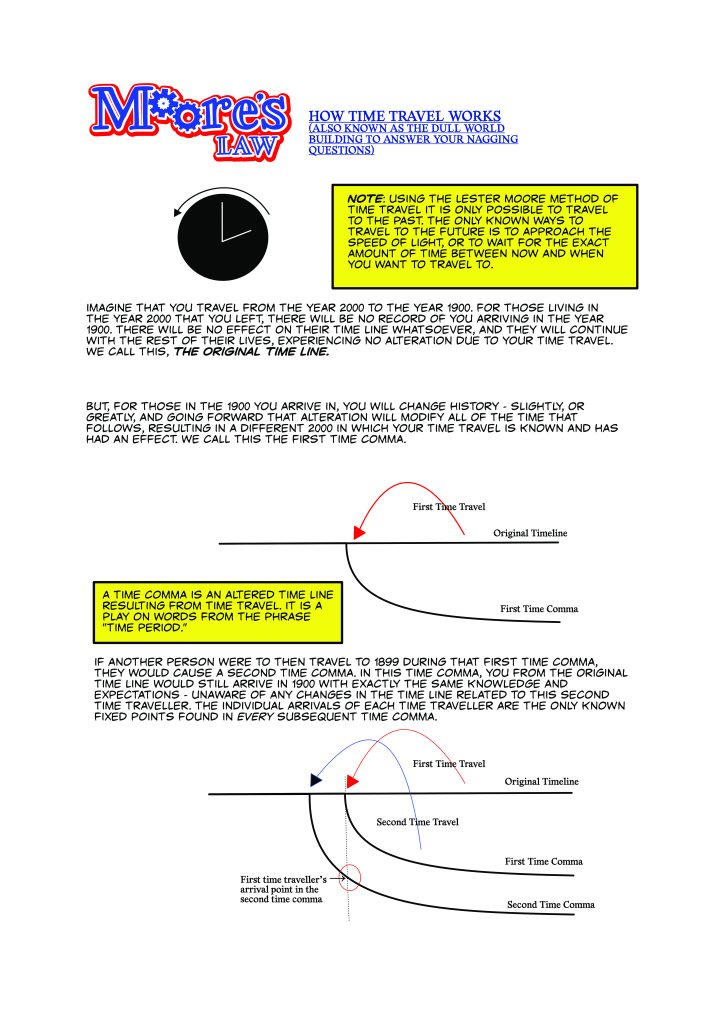
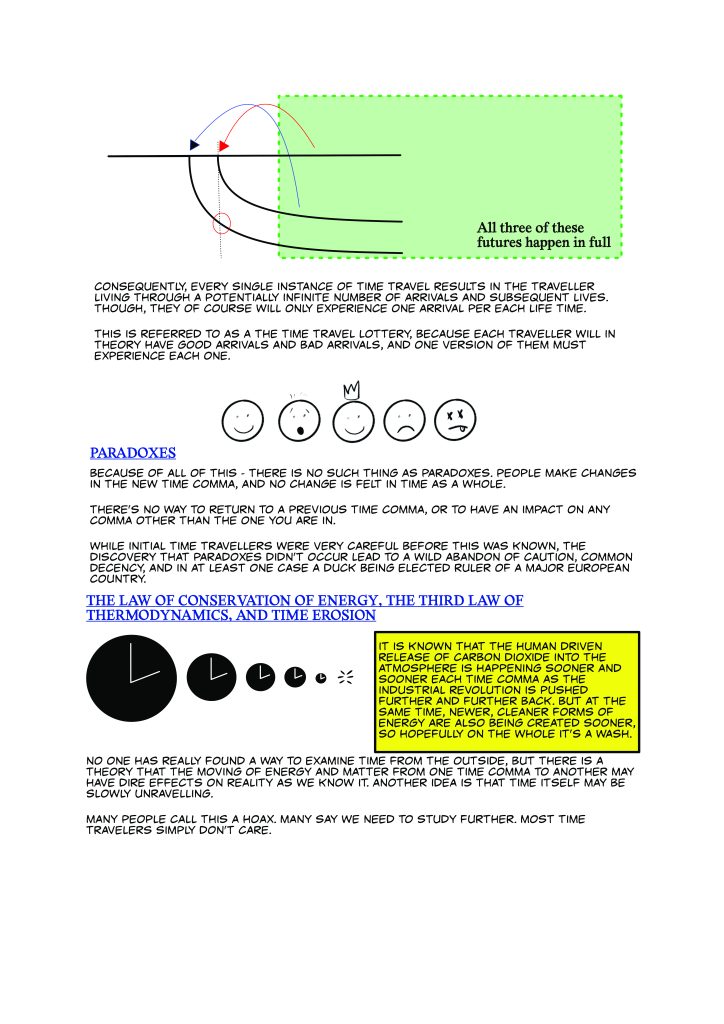
From Moore’s Law issue 1 – here are the rules of time travel in this fictional universe:

An experiment in comics
From Moore’s Law issue 1 – here are the rules of time travel in this fictional universe:
This is a place to experiment with the comics form in a variety of ways, which is a fun way to say that we make comics and are pretentious. But like fun pretentious, you know.
We will be putting out our newsletter as soon as we’re up and running, and working on a variety of comics projects.
NOTE from site: This post was written by David den Ouden, who’s worked on all 3 of the Doe Het Niet Zelf Dutch Graphic Novel weekends. It has not be further edited by the site owner.
If you want to publish a graphic novel made in 48 hours, you need 2 things:
‘Just’ creating two page spreads is not enough. The art work needs to be scanned (if on paper), processed and made ready for print.
Based on experiences with GNW Utrecht 2019, GNW Haarlem 2020, and GNW Amsterdam 2021, we had some lessons learned. So we have some practical tips.
If you work on paper:

Some possible solutions:


With the previously mentioned GNW’s we did not only work in black and white (= time saver, aka speed), but also in gray. Which can work very well. But you have to make sure you can print it in the same quality as the art work itself.
If you work in gray, for the final printed graphic novel, you want your blacks to be truly black and the gray to have all the nuances and levels as the original art work. You do not want your black lines to turn out dark gray or black-ish. It kills the page.
How to do the scanning properly, is described in the next section.
These practical tips we’ve learned the hard way; it will give you better quality and in the end save a lot of time.
So:
1. If you draw on the same sheet of paper:
2. If you draw your black and white (line) art on one sheet and the gray on another (using a light box):

Those 2 emphasised sentences are really important. I’ve learned the hard way with GNW Haarlem 2020. The art work was scanned in black and white at the event. Back home, doing post production, I scanned the gray page on another scanner. It was impossible to line up the 2 scans; rotating and correcting for distortions did not work. I’ve spent hours cutting up the gray scans of for pages in small pieces, panel by panel to rotate and deform them so they lined up.
Most scanners are not perfect and they all distort pages slightly different. So to compensate for that, use the same scanner. And the same orientation, since the scan might have small distortions from top left to bottom right. Rather have the same distortions in the same places.
Even if the artist is not scanning the art work themselves, it is good to be aware of the process.
If all is fine, you work on the same format as the paper artists.
Preferably you work in 600 dpi. If that is not possible, at least work in 300 dpi.
The industry standard for printing comics is 350 dpi. Which can be an issue if e.g. you have (an older) non-professional version of Procreate. With just using black and white you should be fine, if you use gray scale as well, better check with the organisers of the GNW to see what will work.
We can’t do a whole course on Photoshop and post production here. But there are a few basic things we can mention.
You want the black and white (line) art to be truly that: just black and white.
In post processing we want to optimise the art work, so we have the best quality. If you scan as a document or black and white, the scanner takes all the decisions for you. And you want to make those decisions yourself in Photoshop (or another tool).
To create high quality black and white images, there are different approaches that all work.
I usually take the following steps for processing a scan in Photoshop.
For scans with colours (from pencil or art board paper):
Or otherwise:
Next:
For black and white (line) art scans:
For gray scale scans:
Next: Clean up the scan. Duplicate the layer with the art work (so you preserve processed scan). Erase all specks, errors and other things that should not be in final art work. Usually you do not want anything outside the panels.
Combine the processed gray art work with the black and white (line) art work and make sure they align. This can require some rotation or even a lens correction filter to align them perfectly.
The concept of a graphic novel goes back quite a while, but there first person to use the phrase in its current form, I believe, was Will Eisner in relation to his book “A Contract with God.”
The rough idea is that it’s a long form comic book containing a single narrative. It might contain multiple stories from different points of view, but they all connect to tell one single cohesive narrative.
It is not an anthology
A 48 hour graphic novel is very different from an anthology, which is a collection of possibly unrelated stories, which all fit a single theme. Those are very easy to do in a short term project like the one we’re discussing in this website, because everyone has complete control and can work independently and never talk to anyone else and just make their thing.
A single narrative with everyone working together, on the other hand, requires the communication and community that this type of project was meant to bring about.
A little jam, A little exquisite corpse
Though they are not directly what we’re doing here, the concepts of a comic jam or an exquisite corpse are also worth understanding, because there’s a bit of that to a 48 hour graphic novel. Those are story telling forms where one creator begins, and another takes what they have written, and creates the next section (in a comic jam, it’s usually page by page). It’s a more linear story telling process, where everyone just builds off of the person who came before.
This isn’t really the idea of a 48 hour graphic novel, but it’s more in-spirit with the idea than an anthology is, because it has that component of trying to tell one story together. The difference is, of course that on a practical level in a 48 hour graphic novel, you don’t have time to wait for the each individual before you to finish their part before it’s your turn.
I don’t believe there’s one right way to do anything — but I do generally believe that there are things we can do that will make it easier to achieve a 48 hour graphic novel for the majority of people. I’m just not certain I know them all. In fact, I’m fairly certain that I don’t. So, I’d like to hear from you.
Everything in this webpage is based on what I’ve seen, what I’ve understood, theories I have, and what others have suggested. I want to hear any experience that you’ve had, or ideas and suggestions for solving the many difficulties associated with a project of this sort. So, if you start your own 48 hour graphic novel or participate in one, and notice something, let me know.
I hope it’s pretty clear from the text that I will write about different points of view in the process. I might have my own point of view in there, as well, but in fairness it is my website. And I’ll make it clear when it’s my commentary so people can ignore that part.
So feel free to email me at 48hourgraphicnovel at gmail dot com.
Everyone who does a 48 hour graphic novel is probably going to do it differently, and more importantly, should do it differently and make it their own.
But when you plan out the event, you need to make decisions. The only rules put in to this concept, obviously, is that it’s 48 hours and it’s a graphic novel. Beyond that, it’s open. And point of fact, I don’t even have any control over you doing a 46 hour graphic novel, or a 48 hour quilting bee, so really, even those two “rules” are just guidelines.
The timeline we planned in the very first graphic novel weekend
For the first GNW, we had an evening session on Friday, a full day on Saturday, and worked until 5pm on Sunday (48 hours after the beginning). The beginning evening was mostly planning and discussion, with some work being created. The second day was really the meat of the project. The third day was a mad dash to finish everything. We made sure there were regular meals brought in by caterers and snacks available all day.
We found that over time there was less need for the writers to be present, as the art naturally takes the most time. But Initially, the plan was to have morning meetings with the writers on both Saturday and Sunday. The initial goal was to have act 1 finished the first day, act 2 the second day, and act 3 on the third day. The writers instead planned a structure on the first day and each took a chunk of the story. So that turned out not to be necessary, for us but you might want to do it the way we (i.e. the organizers) originally intended.
We also determined that we wanted people to be able to sleep between the days, to have a more balanced experience than 24 hour comic day can give (after being awake for 24 hours, if you’re writing in sequence, act three is bound to have a few inconsistencies).
But this was what we planned out for that event. There are definitely other options.
Make it your own, but make it
Helmuth von Moltke, a Prussian General who died in 1891, had some advice for those engaging in a 48 hour graphic novel. He said, “No battle plan survives first contact with the enemy.” All the same, it’s still better to have a battle plan. I recommend making a detailed planning of what you expect to happen, and what needs to happen in the project, based on the time you have. Figure out when you want people at the location, when food will be there, when you’ll start, when you’ll end, etc. Things may shift almost immediately, but the next steps still need to happen, and this will help you determine order changes.
From a creative project perspective (be it a film, a book, a work of art, etc.) the most important thing is having proper credit. This is what makes it easier for creators to get additional work, to use any creative project’s final results as a CV, and for consumers to follow up and find that creator’s other works easily. It can show not only that they were involved, but what they did, and what they are capable of doing.
When making any comic project, it’s important to note what creators did what on a page by page basis.
The other reason we do this
The American comic book industry had some real difficulty over the years giving the creators their due (from important creators like Carl Barks and Bill Finder to lesser known figures there are so many stories of creators who almost went uncredited completely and suffered because of it), so it’s become a very important part of any comic project from a different perspective. It’s part of comic creator ethos and now-a-days, not giving specific credit is considered pretty unethical except in cases where creators intentionally want to remain secret, and even then they usually use a pseudonym.
European creators have used pseudonyms in comics for other reasons, of course – Hergé, Peyo, etc. It’s as important to respect that aspect of things as it is to give credit, of course.
NOTE: Admittedly, the process of giving credit to mangaka assistants in manga is a bit murkier to me (as I do not read Manga in its native language), but as I understand it they are generally credited in some way, though it can be a lot less clear to readers. But there you have a real structure that helps people get work in the industry, and a very large industry. Also, in that case, the assistants are literally there (in theory) to assist one person’s vision working in a technical capacity, and in the case of 48 hour graphic novels, everyone is there working as equal creators. So this is not a good analogue for what we’re doing. Also, manga assistants deserve every bit of credit they can get.
Make it easier to track
So as you finish a page, it’s a really good idea to write up exactly what every creator did on that page so that there is a clear listing that can be put into the final book.
I will go into these topics much more in depth through out this webpage, but I wanted to write up a list of what I believe is necessary at the minimum to make a 48 hour graphic novel work. These projects could be widely varied, but there are a few things that seem to be universal to this sort of project:
*This is not to say that everyone involved should be comic experienced – this is to say that some of the people involved should have experience with comics. Comic creation and structure is a whole world unto itself, and it’s important to have at least a few folks who are intimately familiar with the format.
NOTE: It’s a good idea to read the starting points post before this one.
People spend decades writing books and screenplays sometimes. This project is just a couple of days. So there’s a real need to figure out the plot and how everything will work together quickly. There are a lot of options available.
Simple plot explanation
A plot will need to have a beginning, middle, and an end. During the first GNW, I created a example in comic form:

The basic ideal being that in the beginning we figure out who the character is, and how they get into a problem. Then we have them face difficulty of some sort. Finally, we find a way for them to triumph (or in the case of tragedies, fail).
This may seem incredible straightforward, but it’s essential to determine the beginning, middle, and end, so that everyone knows what they are working towards. This doesn’t need to be done at the beginning, it could be figured out on the way, but readers expect this structure.
“Save the Cat”
Blake Snyder’s book, “Save the Cat” is a classic review of structure in Hollywood screenplays. It gives a quantitative structure of what needs to happen and where – minute by minute – in a film. It’s hard to use this as a one-to-one resource in a 48 hour graphic novel, as you will not know at the beginning how many pages you have to tell the story, but so far as giving a clear outline where you just need to slot in moments, it might be a good resource to review.
There are also a number of resources online to map out “standard” structures for various genres (mystery, romance, thriller, etc.)
Some people feel that following this sort of pre-fabricated structure makes films and books a bit too formulaic, and that might be true (I absolutely believe it’s true, but what do I know?). All the same, this will make the story familiar, and act as a guide for you in this process, and you might find that useful given the short timeframe available.
Story board
It might be useful for the writers to layout the story on a story board, either visually (possibly using the thumbnail drawings recommended) or with text post-it notes. This gives the ability to move concepts around, and see how everything fits.
This is also helpful to the artists – one of the biggest things we heard from artists in the first graphic novel weekend was that they wanted to know where they fit into the story. So having a large story outline where they can picture a little drawing of themselves and the words “you are here” will be very appreciated.
Let your freak flag fly!
The artists are likely to want to draw weird things. Few artists come to a comic book related project expecting to draw two people sitting at a table hashing out an argument. So, even if the writing team finds a story they want to tell that’s relatively straightforward and grounded, it would be a good idea to find a way to make sure that the artists can draw some more bizarre things. Structuring the plot around dream sequences, museums, film shoots, etc. can add that sort of spice into an otherwise straight ahead story.
Any advice given here is just that, advice. You will need to find your way to navigate this process.
Be yourself
You are yourself. You have an artistic method and outlook that is yours. You can play around with all of the tools provided at the event, and learn new techniques, but be yourself. Bring what you have to the table. Everyone is different, and there is no better or worse in this event, only different. So bring your uniqueness to this project, and find a way to make it work with everyone around you.
And don’t worry if you feel like your art won’t fit in with what other people are doing. Everyone naturally plays off of each other a bit, and interestingly when everything is in black and white, we found it all naturally looks like it fits together. This is especially true if you’re using the tools provided.
SPEED, SPEED, SPEED
The name of the game is speed. 24 hour comic day (which is our inspiration) participants finish pages in 1 hour on average. Each page in this project might take longer, but if you can do something to make the pages go faster while still telling the story, do!
You have the hardest and most fun job in this event. The key is to make things easier for yourself:
The key is to pick your battles – spend extra time when you’re working on important panels.